“nasa gone rogue” sounds like they’re stealing rockets and going to the moon illegally or something
but nope, “rogue” these days is a word that means “posting real climate change facts that your president doesn’t want you to know”
like if you support nasa posting real climate change facts that the orange dictator doesn’t want you to know. reblog if you support nasa stealing rockets and going to the moon illegally.
Pierre Jean-Louis is a multimedia artist based in New York and Philadelphia, who has built up quite a social media following as a result of his unique works. Jean-Louis paints mystical images of the universe and nature onto images of Black women’s natural hair. His intricate works feature flowers, vines, and even an entire forest, all seamlessly woven into coils and kinks. Jean-Louis even invites his followers to tag him in their photos on Instagram so that he can consider their portraits as well.
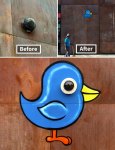
My favorite part is that these are going to be someone’s neighborhood landmarks. “Turn left at the saxaphone player,” “yeah I work in the shop right next to the Princess Leia fire hydrant,” “if you pass the shady guy selling watches, you’ve gone too far.” The urban and suburban worlds are so funny of random infrastructure points that you’re just supposed to ignore, like those big metal wiring cabinets on the side of the road and all those backflow preventers all over the place. With just a little paint, now they have friendly, comprehensible meaning.
A whole roasted cauliflower behaves very much like a roast of meat, in the oven and on the table.
A whole roasted cauliflower behaves very much like a roast of meat, in the oven and on the table.
i’m having a stroke
is it taste good?
A whole roasted cauliflower behaves very much like a roast of meat, in the oven and on the table.
A whole roasted cauliflower behaves very much like a roast of meat, in the oven and on the table.
A whole roasted cauliflower behaves very much like a roast of meat, in the oven and on the table.
is it taste good?
A whole roasted cauliflower behaves very much like a roast of meat, in the oven and on the table.
i’m having a stroke
Is it taste good?
A whole roasted cauliflower behaves very much like a roast of meat, in the oven and on the table.
I’m having a stroke
is it taste good?
I The New York Times ih Like Page
A whole roasted caulflower behaves very much like a roast o meat, in the oven and on the table:
Video: Roasted Cauliflower
Aunhol roasted caulfower behaves vey much ke a roast of meat, in the oven ard on the able
I am an image transcribing bot which uses Tesseract OCR to translate images to text. I’m far from perfect but I try my best! Most of you are welcome, friendly Human®. | PayPal | Patreon
I’m
Having a
Stroke
A whole roasted cauliflower behaves very much like having a stroke, but is it taste good?
A remarkable Jacobean re-emergence after 200 years of yellowing varnish Courtesy Philip Mould
PAINT RESTORATION OF MESMERIZING
I saw this on Twitter. He’s using acetone, but a cellulose ether has been added to make it into a gel (probably Klucel—this entire gel mixture is sometimes just called Klucel by restorers, but Klucel is specifically the stuff that makes the gel).
Normally, acetone is too volatile for restoration, but when it’s a gel, it becomes very stable and a) stays on top of the porous surface of the painting, and b) won’t evaporate. So it can eat up the varnish.
It looks scary, but acetone has no effect on oils, and jelly acetone is even less interactive with the surface of the paint or canvas.
Will someone PLEASE clean the mona lisa
For those who are wondering, they cleaned a copy of the Mona Lisa made by one of Da Vinchi’s students, and here’s a side by side comparison:
CLEAN THE FUCKING MONA LISA.
A couple problems with cleaning the Mona Lisa:
The Mona Lisa is a glazed painting.
A Direct Painting is one in which the artist mixes a large amount of paint of the correct value and shade the first time, and applies it to the painting. A Glazed Paintingis a painting in which an underpainting is painted, generally in shades of gray or brown, and a allowed to dry, before layers of very thin glaze – a mixture of a tiny bit of pigment and a lot of oil – is applied to the surface. Some artists, such as Leonardo, choose to work this way because it provides an incredible sense of light and illumination (look at how the real Mona Lisa seems to glow).
The Mona Lisa is an incredible work of glazed painting, but that makes it fragile, so fragile that many conservators don’t want to work on it because it’s extremely difficult and a conservation effort go wrong for many many reasons. One of the reasons it could go wrong is that the glazes and the varnish layers are actually a very similar chemical composition, and a conservator could accidentally strip off layers of glaze while removing the varnish.
In fact, in 1809 during its first restoration when they stripped off the varnish, they also stripped off some of the top paint layers, which has caused the painting to look more washed out than Leonardo painted it.
The Mona Lisa also has a frankly ridiculous amount of glaze layers on it, as Leonardo considered it incomplete up until he died, He actually took it with him when he left Italy (fleeing charges of homosexuality), meaning it never even got to the family who had commissioned it, and instead constantly altered it, trying to get it just a touch more perfect every time. That makes it really fragile, with countless layers of very thin paint, many of which have cracked, warped, flaked, or discolored. It’s not just the top layer, its layers and layers of glazing throughout the painting that have slowly discolored or been damaged over time.
Speaking of damage, look at the cracking. That’s called craquelure; it happens with many painting’s (even ones that aren’t painted with this technique) because the paint shrinks as it dries, or the surface it’s painted on warps. Notice that the other painting has very little of it, even though it’s almost the same age.
The reason the Mona Lisa has so much craquelure is because Leonardo was highly experimental, almost to the point of it being his biggest flaw. There were established painting techniques, and then there were Leonardo’s painting techniques. The established painting techniques were created in order to insure longevity and quality, but Leonardo didn’t stick to any of them. This has made his work a ticking time bomb of deterioration.
Don’t believe me, check it out:
This is how most people think The Last Supper looks
But this is actually a copy done by Andrea Solari in 1520.
The actual Last Supper looks like this:
The Last Supper has been painstakingly and teadiously restored, with conservators sometimes working on sections as small as 4 cm a day. To get to it you’ve got to walk through a series of airlocks (AIRLOCKS!?!?!) and they only allow 15 people at a time because the moisture from your breath and your skin particles will damage it. Despite all of the precautions and restoration, it still looks like that.
This is because Leonardo painted the last supper using highly experimental methods. He didn’t use the traditional wet-into-wet method that fresco painters used, and insead painted onto the dry plaster on the wall, meaning the paint did not chemically adhere. Before he even died the painting had already begun to flake. It’s a miracle it’s still there at all.
They’ve done what restoration they can on The Last Supper because the painting will absolutely disappear if they don’t. The Mona Lisa, which is delicate, but much more stable, doesn’t need the same kind of attention. And, like many of his works, is just too delicate to touch, and the risk of doing irreparable damage to it is far too high. The Mona Lisa is insured for something like 800 million dollars, and that’s a lot of money to be ruined by one wrong brush stroke. (fun fact: the most expensive painting ever sold was also a Leonardo, the Salvator Mundi, and it went for 450 million dollars.)
Furthermore, there are probably only 20 or so authenticated Leonardo paintings in the whole world. If you look through the list, most of them aren’t even fully done by him, are disputed, or aren’t even finished. It’s simply too difficult and too risky to restore the Mona Lisa, one of Leonardo’s only finished and mostly intact works, when there’s hardly any more of his paintings to fall back on.
Now the painting you see in the video above is 200 years old, not 600 years old, and I assure you, the conservators decided the risk to restore it was minimal (after extensive research, paint testing, x-raying, gamma radiation, etc.) and that the work they were doing was worth the risk based on the painting’s value.
Conservators make the decision all the time about how much they can do for a painting, because really, they have the ability to completely strip a painting of all varnish and glazes and just repaint the whole thing (which happens to a lot of badly damaged paintings, especially when there’s no way to save them – one of the very small museums in my area recently deaccessioned a Monet because it was barely original, and no one wants to look at a Monet that’s only 20% Monet’s work) – but doing that to the Mona Lisa, removing the artist’s hand from the most famous piece of artwork in history? Hell No.
(also, I’m not a conservator but I’ll be applying to a conservation grad program sometime next year, so sorry if any of my info is at all inaccurate)
I found this really interesting, thanks for sharing.


























 Motherfucking Cowboy Meowchow